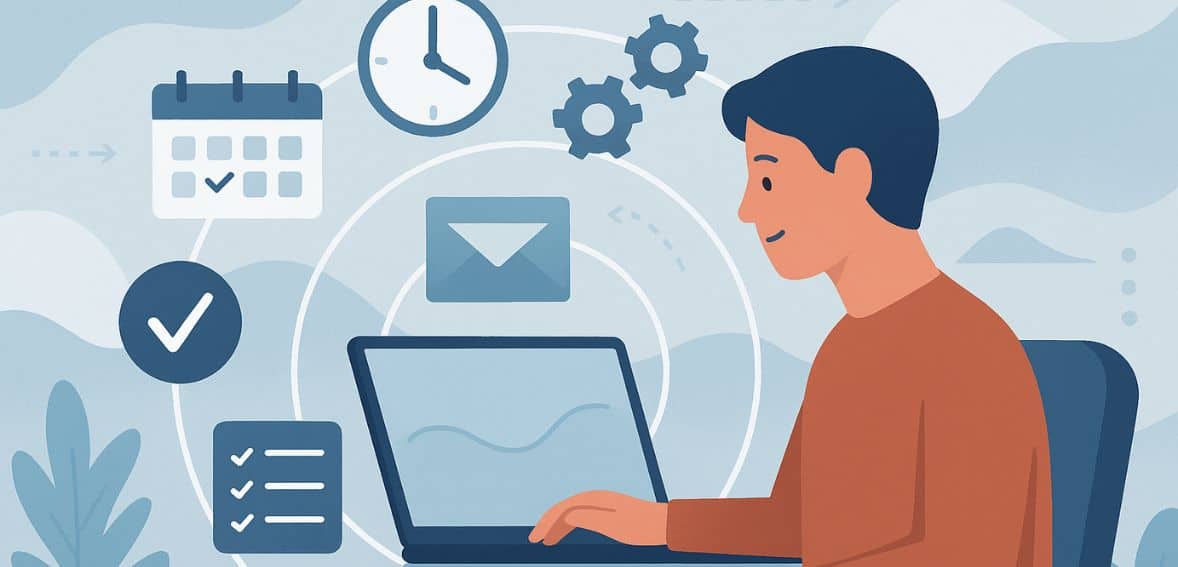
Automating Daily Tasks has become essential in today’s fast-paced world. The feeling of chasing endless to-do lists and still wondering where the day went is something that every professional has experienced. Our days are repetitive because we have to respond to emails, set up meetings, manage tasks, and process information.
That has been modified by automation. The goal is to streamline repetitive tasks so that people can focus on work that truly matters, rather than replacing jobs with robots. Automating everyday tasks doesn’t require costly equipment or technical know-how.
It merely entails identifying trends and developing mechanisms that address them on your behalf. Less burnout, increased focus, and weekly hours recovered are the outcomes. Automation is now a necessity for sustained performance, productivity, and mental clarity in today’s digital world.
The Psychology of Automation

Automation is effective because it frees the mind from having to make decisions all the time. Mental energy is used in all repetitive tasks, such as sorting messages, updating files, and sending follow-ups. This is known by psychologists as “decision fatigue,” and it impairs one’s ability to think strategically or creatively.
You can save your mental energy for tasks that actually call for human judgment by automating these repetitive tasks. Automation gives people a sense of control that goes beyond efficiency to include freedom.
You are now creating your day rather than responding to it. Professionals can think ahead, innovate, and perform better because of this mental clarity. The true power of automation is not found in the tools per se, but rather in the way they free you up to concentrate on work that has a purpose rather than repetitive duties.
Choosing What to Automate
Finding the things that slow you down every day is the first step towards successful automation. Not all tasks should or can be automated. Repetitive, rule-based, and time-consuming candidates are the best ones.
For example, regular follow-up emails, invoice reminders, and recurring calendar invites are excellent places to start. As a general rule, it’s worthwhile to automate tasks that you perform more than three times per week.
Automation means reducing needless repetition, not doing away with human intervention. Although systems take care of the background work, you remain in charge. The goal of switching from manual to automatic processes is not only to save time, but also to get rid of minor inefficiencies that steal hours each week.
Automating Your Inbox
One of the biggest time wasters in modern work is email. Sorting, responding, and archiving messages that don’t need their attention takes up hours for most professionals. This chaos becomes order when you automate your inbox.
Simple filters can direct client messages into specific queues, invoices to finance, and newsletters into folders. Automated responses can quickly confirm appointments or acknowledge receipt.
More advanced systems employ artificial intelligence (AI) to rank emails according to urgency and importance, assisting you in concentrating on the important things. Simplifying communication rather than depersonalizing it is the aim. Your inbox turns into a workspace rather than a distraction trap when technology takes care of sorting and follow-ups.
Smart Scheduling and Calendar Management

Another significant source of time waste is scheduling. It may take more time to plan meetings, verify availability, and send reminders than the actual meeting. This is resolved by automation, which uses intelligent scheduling tools that work with your calendar and let others reserve available times without requiring a lot of back-and-forth emails.
These systems can send confirmations, automatically add video links, and even recommend the best times for meetings depending on time zones. Another way to cut down on clutter and missed deadlines is to pre-schedule recurring meetings or project check-ins.
Your day becomes stress-free and predictable with calendar automation. You finally have control over time instead of chasing it, which frees you up to concentrate on meaningful collaboration rather than logistics.
Simplifying Data and Reporting
Reporting and data entry are necessary but time-consuming. Due to automation, systems can now communicate with one another and move data between apps without the need for human input. Spreadsheets, CRMs, and dashboards, for example, can be automatically updated with customer data entered into a web form.
This guarantees accuracy and gets rid of human error. By producing performance summaries in real time, automated reporting goes one step further and enables leaders to take prompt, well-informed decisions.
Professionals can concentrate on analyzing the insights rather than spending hours creating reports. Data management becomes a strategic advantage through automation, allowing teams to focus on growth rather than spreadsheets.
Automating File Organization
Every week, hours can be silently consumed by digital clutter. By automating file organization, reports, documents, and images are placed precisely where they should be without requiring human intervention. Using folder rules and naming conventions, cloud storage platforms such as Google Drive or OneDrive can automatically arrange files by date, client, or project.
When automation is integrated, each file that is scanned, uploaded, or emailed immediately finds its correct location. This eventually removes the aggravation of looking through countless folders or items with incorrect labels.
Because teams always know where to find the most recent version, consistency becomes effortless, and collaboration improves. In addition to looking neat, a tidy digital workspace improves concentration and avoids the silent chaos that eats up time and productivity.
Financial Automation Made Easy

Automation makes money management easier, but it can still feel overwhelming at times. Healthcare practices can also optimize your revenue cycle without hiring extra staff to strengthen financial workflows, reduce manual errors, and improve overall revenue performance.
Software for invoicing can be used by businesses to track payments, send reminders, and send bills automatically. Automated payroll processing ensures accuracy and compliance without requiring additional work.
Individuals can avoid missed deadlines and financial stress by automating bill payments, savings transfers, and expense classification. Apps for smart budgeting even examine spending trends and modify savings targets as necessary. Consistency, not convenience, is the main advantage of financial automation.
Predictability in money management lowers anxiety and frees up time for planning instead of paperwork. Your attention shifts back to building rather than balancing when your finances are operating smoothly in the background.
Streamlining Project Management
Miscommunication and redundant updates are common problems in team projects. Collaboration is revolutionized by automation, which builds self-updating systems. A project’s next phase may start on its own when the previous one is finished. File sharing, status updates, and reminders all take place automatically.
This guarantees more efficient processes and fewer missed deadlines. In order to keep everyone updated without holding additional meetings, project management tools can also be integrated with communication platforms.
Team members get updates immediately rather than having to chase them down. The end effect is a transparent and accountable culture where work is done naturally. By eliminating conflict and misunderstanding, automation enhances teamwork rather than replacing it.
Customer Communication and Support

Automation has completely changed how companies interact with their clientele. Simple questions like resetting passwords or checking the status of an order are now instantly handled by chatbots and helpdesk tools.
This guarantees prompt service while allowing human agents to handle delicate or sensitive issues. Personalized messages, such as reminders for renewals or follow-ups following purchases, can also be sent by automated systems. The secret is striking a balance between human empathy and automation for speed.
Customers are more satisfied and trusting when they receive prompt, accurate responses without having to wait for hours. Intelligent automation enhances connection rather than replacing it. Even when technology is used in the background, it guarantees that every interaction feels intimate.
Automating Social Media and Marketing Workflows
One of the most time-consuming daily tasks for freelancers and small businesses is manually managing social media. Planning, scheduling, and publishing content across several platforms without constantly logging in is made simpler by automation tools.
A week’s worth of content can be produced all at once, and timing, consistency, and audience engagement can be left to automation. Even advanced instruments can automatically recycle evergreen content or analyze the best times to post. Marketing automation supports personalized outreach campaigns, lead nurturing, and newsletter management in addition to social media.
Once requiring hours of manual posting and tracking, this process now takes place in the background, freeing up marketers’ time to concentrate on strategy, creativity, and storytelling rather than logistics. Here, automation refers to the presence without pressure.
Balancing Efficiency with Humanity
Human labor should not be replaced by automation; rather, it should be enhanced. The most effective systems enhance people’s capacity for creativity, empathy, and problem-solving. Employees have more time for critical thinking, creativity, and connection when technology manages repetitive tasks.
Because more meaningful engagement results from fewer mechanical tasks, this balance also helps to prevent burnout. The message is clear for leaders: automation is a tool to help, not a danger. More human beings—liberated from busywork and concentrated on what really matters—rather than fewer humans, is the aim.
When efficiency and empathy coexist, workplaces become places where people and technology flourish. This is where true productivity occurs.
Personal Productivity Automation
Automation can significantly simplify personal life as well as professional tasks. Bill payments, fitness tracking, grocery reorders, and calendar reminders can all be automated. Smart assistants can set up daily tasks like playing music in the morning, sending reminders, and turning on lights.
You will have more mental room for long-term objectives the less time you spend on life’s little details. You can stay focused without feeling micromanaged due to automation, which establishes a structured rhythm.
You begin each day with clarity rather than chaos. Professional performance inevitably improves when personal systems function well. In actuality, productivity starts with how you manage your time, energy, and habits outside of your desk.
Overcoming Resistance to Automation
Many people are reluctant to automate despite its advantages because they fear complexity or losing their jobs. In actuality, modern automation tools are inexpensive, easy to use, and made for all users, not just IT specialists.
Start small: automate email filtering, recurring reminders, or invoice tracking. Every little accomplishment boosts self-esteem. It’s critical to convey the goal of automation, which is to enable people to perform higher-value tasks rather than to replace them.
Early adopters of automation frequently report happier, more effective teams. When people understand that automation eliminates drudgery rather than dignity, resistance wanes. Progress—streamlined processes that provide greater time management to all—is the aim.
Measuring the Impact of Automation

Automation has positive effects on every aspect of life, not just the hours saved. As attention moves from managing tasks to accomplishing goals, productivity rises. People who multitask less experience less stress.
Automation improves customer experiences, reduces errors, and speeds up response times for businesses. Metrics like cost effectiveness, employee satisfaction, and turnaround time can be used to gauge the impact.
However, greater creativity, improved relationships, and the sense of working with technology rather than against it are the qualitative results of automation’s true success. Humans rediscover the energy to create, connect, and develop when systems take care of the routine.
The Future of Work: Automation as an Ally
The future isn’t whether automation will replace humans, but rather how we will work with it. As technology advances, it will be able to anticipate problems, predict needs, and provide answers before we do. Automation will become a silent partner that streamlines everything from scheduling to decision-making in both personal and professional spheres.
Those who adjust will redefine productivity itself, not just save time. The most successful professionals will be the most focused, not the busiest. Automation is about doing better, not more. Those who carefully automate will always have the upper hand in a world where time is the most valuable resource.
Conclusion: Simplicity That Multiplies Time
Automation isn’t about removing the human touch—it’s about amplifying it. By automating small, repetitive tasks, we reclaim hours that can be spent on creativity, relationships, and growth. The power of automation lies in its simplicity: small systems that make a big difference.
Over weeks, those saved minutes compound into days of regained productivity. It’s not about becoming robotic—it’s about becoming more human by letting technology handle the mechanical. The future belongs to those who understand that efficiency is freedom. When machines take care of the routine, humans can finally focus on what no algorithm can replicate—thinking, dreaming, and leading with purpose.
FAQs
What types of daily tasks are best suited for automation?
Tasks that are repetitive, rule-based, and time-consuming—such as data entry, scheduling, reporting, and follow-up communications—are ideal candidates for automation.
Do I need technical skills to automate everyday tasks?
No. Many automation tools are designed for non-technical users and offer drag-and-drop workflows, templates, and guided setup.
How quickly can automation start saving time?
In many cases, time savings appear within the first week as automated workflows replace manual steps and reduce interruptions.
Is automation expensive to implement for small teams?
Not necessarily. Many tools offer affordable plans or free tiers, making automation accessible even for small businesses or individuals.
Can automation reduce errors in daily work?
Yes. Automating routine tasks reduces human error by ensuring processes are completed consistently and according to predefined rules.